


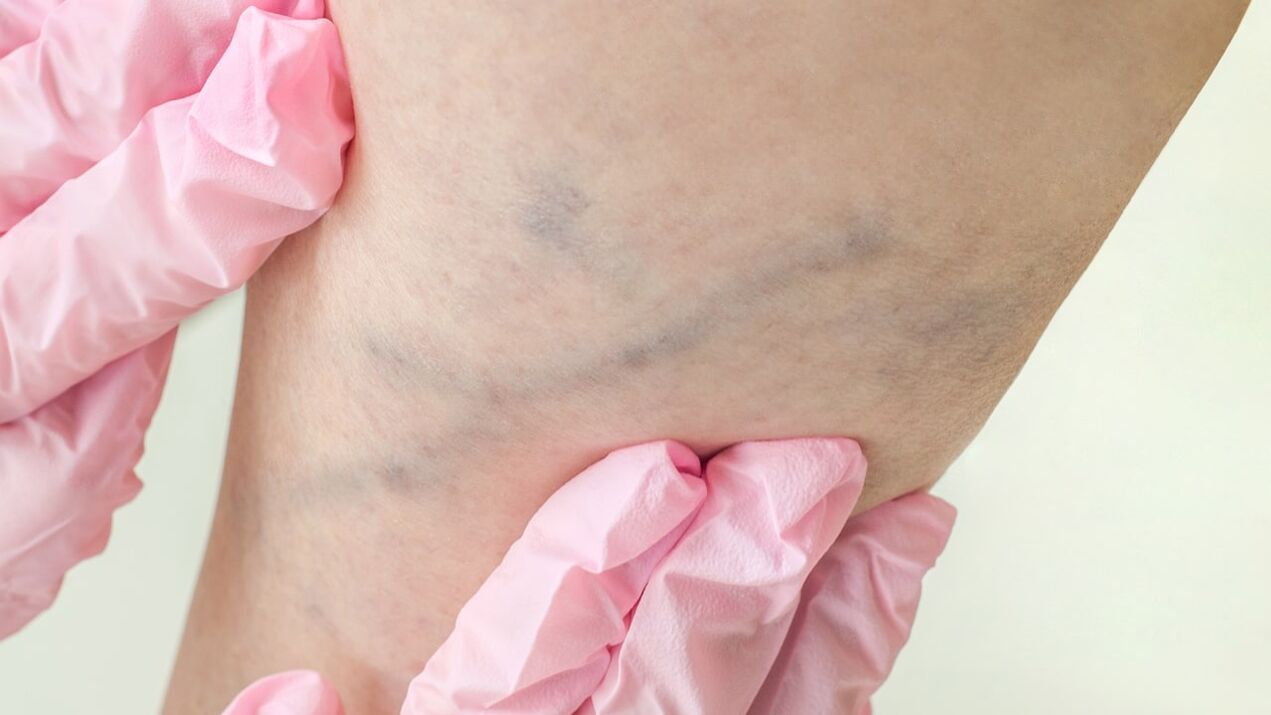
Varicose veins of the legs are a disease of the saphenous veins, during which their pathological expansion develops.Varicose veins are swollen varicose veins that usually develop in the legs.Varicose veins develop more often in women than in men.For a long time, varicose veins were only a cosmetic problem (spider veins), but if varicose veins are not treated, they constantly progress and can cause complications over time.The main complications - trophic ulcers, thrombophlebitis, skin color changes develop in 70% of patients with varicose veins without treatment.
Symptoms of varicose veins
- Enlarged dilated veins in the legs
- Heaviness in the legs, fatigue in the evening
- Swelling of the legs after physical exertion in the evening
- Discoloration of the skin on the lower limb
- Inflammation of diaper veins - thrombophlebitis
- Trophic ulcers of the skin
Varicose veins causes and risk factors
- Difficult inheritance - congenital failure of the valve apparatus
- Heavy physical work while standing
- Frequent pregnancy and childbirth
- Walking in high heels
Modern methods of treating varicose veins of the lower limbs in our clinics make it possible to solve this problem without serious surgical interventions, without pain, wounds and hospitalization.
The modern level of phlebology makes it possible to treat varicose veins painlessly, very aesthetically and reliably for the patient.The first signs of varicose veins should be the reason to contact a phlebologist.Varicose veins of the lower limbs imply a complete disappearance of the tone of the venous wall, therefore it is useless to affect the varicose transformation with tablets and pills as a means of treatment.
diagnosis
Complaints and symptoms
Varicose veins begin with the appearance of separate nodes of dilated veins and steadily progress.Varicose veins do not cause any problems at first, but over time they become a risk factor for serious health risks.So, let's take a look at the main problems that suffer from patients with varicose veins:
Cosmetic discomfort
Most patients with varicose veins complain only of unpleasant varicose veins that spoil their legs.Such complaints are especially often caused by varicose veins in women.Small varicose veins and spider veins often cause cosmetic discomfort, which do not threaten health, but force the legs to close.Such patients need treatment for cosmetic reasons, so only minimally invasive (no incision) methods are recommended for them.
Chronic venous insufficiency
About 30% of patients with varicose veins complain of heaviness in the legs, evening swelling and night cramps in the calves.These are signs of chronic venous insufficiency.Gradually, its symptoms worsen and painful sensations may appear in varicose veins.Skin changes and pigmentation develop.With severe venous insufficiency, the skin of the lower third of the leg can be damaged by the formation of a trophic ulcer, which is difficult to treat.Often, patients with prolonged varicose veins develop skin inflammation - eczema.
Examination by phlebologist
If varicose veins cause you any discomfort, it is necessary to consult a phlebologist.Examination is carried out lying down and standing up.The patient should fully open the legs.
Varicose veins are diagnosed during a routine examination, which should be performed on the leg while the veins are full.An ultrasound duplex scan is always necessary after the examination.As a rule, such a diagnosis will be enough.However, in case of suspicion of secondary varicose veins, it is necessary to examine the deep venous system.
Ultrasound scanning of veins
In the case of varicose veins, ultrasound of the veins is assigned to determine the incompetence of the venous trunks, dysfunction of the venous valves, and identify blood clots in the superficial and deep venous systems.
The examination begins with an examination of the veins of the diaper while standing.The diameter and patency of the large and small saphenous vein is studied, the consistency of the valves is determined (Valsalva maneuver - tension of the abdominal muscles with full inhalation, reverse blood flow is a sign of incompetence).Perforated veins in typical locations and their viability during the Valsalva maneuver are then studied.
After evaluating the superficial veins, it is necessary to evaluate the patency of the deep veins.For this purpose, while lying down, the popliteal and femoral veins are examined, and their patency and consistency of the valves are also evaluated.
Contrast venography
Usually, an ultrasound scan is sufficient for a complete diagnosis of venous pathology, but in some cases it is necessary to study the state of the deep and superficial venous system, especially in the case of varicose veins and recurrence of secondary varicose veins.
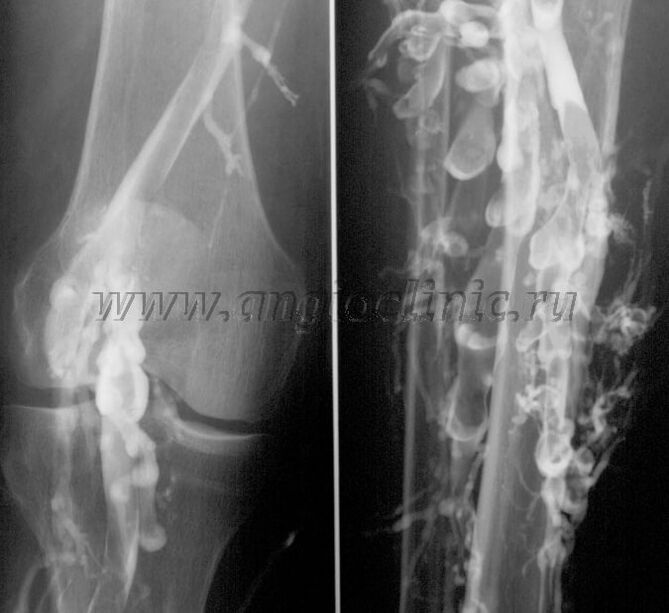
Contrast X-ray examination is used to solve these problems.Saphenous veins are punctured and contrast is injected.The movement of the contrast is observed on the monitor of the X-ray machine and all necessary tests and projections are performed.Currently, venography is used very rarely for varicose veins.
treatment
The "classical" operation of varicose veins under anesthesia with incisions in the groin area and along the legs, which was used to remove superficial varicose veins at the beginning of the last century, is an atavism of the past.Suffering of patients, long hospitalization and pain in the legs after such operations, which are aimed at improving blood flow, are completely unjustified.Severe varicose veins can be treated without "inquisition methods".Today, extended treatment of varicose veins can be performed without anesthesia and hospitalization.A phlebologist's work is office-based, without the trappings of major surgery.
Knowing what causes varicose veins in the legs has allowed us to develop hemodynamic principles of treatment.They can be performed by removing or shutting off the vein from the blood stream.Modern technologies are based on the principle of fusion of venous walls in the area of insufficient venous valves.The method of influencing the venous circulation may be different, but its purpose is the same - to stop the pathological discharge of blood through the damaged vein (anti-reflux).
How to cure varicose veins on the legs?
Understanding the cause of varicose veins allows you to choose the right treatment method.The aim of modern treatment of varicose veins is to solve several problems:
- Termination of pathological discharge in the vertical position with incompetent saphenous veins of the lower extremities.
- Elimination of reflux between deep and superficial veins - perforators - the main mechanism of development of varicose trophic ulcers.
- Varicose - removal of degenerated surface vessels (varicose veins).
- Compression therapy using special socks and stockings.
Vascular center capabilities
Thermal methods of treating varicose veins are endovenous laser coagulation (EVLC) and radiofrequency obliteration (RFO) of the veins of the lower extremities.
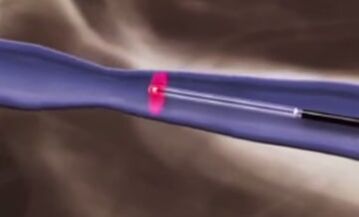
Endovenous laser coagulation is an effective treatment of varicose veins, the principle of which is based on the thermal effect of laser energy.This treatment was introduced in 2001 and is still the best method.During laser coagulation, the damaged vein is heated by a laser beam, which provides a strong effect of damaging the collagen of the vein wall, which leads to the inflammatory process in the vein and its excessive growth.Advanced varicose veins on the legs, which are treated with this method, are completely and without a trace reversed, and its main symptoms disappear: swelling, heaviness in the legs, hyperpigmentation of the skin.
EVLT begins with the installation of laser fibers into the lumen of the varicose vessel through a skin puncture, which is conducted along the damaged vein at the site of the incompetent valve.For the patient, this method is a safe, painless and reliable way to prevent the further development of the disease and its complications.Complete elimination of varicose veins is observed in 98% of patients with proper use of the EVLT method.The possibilities of this method make it possible to treat varicose veins on legs in women, as well as to correct venous outflow in trophic ulcers.
Radio Frequency Obliteration (RFO)
The treatment of varicose veins by the radiofrequency obliteration (RFO) method is a similar thermal method, but the venous wall tissue is heated according to different physical principles due to radio wave energy.Radiofrequency obliteration allows you to remove varicose veins and eliminate its symptoms;Such treatment in its immediate and long-term results does not differ from EVLT, but is more painful for phlebologist.
Other thermal methods
When deciding on the treatment of varicose veins, phlebologists often used exotic methods.Varicose veins were treated with thermal effects using superheated steam and bipolar electrocoagulation.However, modern thermal methods are more effective and they allow the doctor to prevent the further development of varicose veins, while treating the patient on an outpatient basis without disturbing his lifestyle.In the hands of a novice phlebologist, thermoablation methods can cause unpleasant complications: decreased sensitivity, burns, rings.In the hands of an experienced phlebologist, the efficiency of this method is more than 98%, and the laser method and RFO make it possible to get rid of not only the initial shape, but also pronounced varicose veins on the legs without incisions.In the photos of the "Results of Treatment" section, you can see the view before and after the minimally invasive treatment.
Non-thermal methods of eliminating reflux of the stem
For many years, phlebologists have been thinking about how to treat varicose veins of the lower extremities without incisions and pain.The disappearance of the saphenous veins in the arms after frequent injections gave rise to the idea that some substances can cause inflammation of the walls of the veins - thrombophlebitis and their subsequent adhesion with the disappearance of the vein lumen.After the emergence of Fegan's method, when the treatment began based on the underlying cause of varicose veins, the development of non-thermal scleroblading methods began.Since then, varicose veins on the legs, especially in women, are treated not only with a scalpel, but also with a syringe.
Sclerotherapy
Sclerotherapy appeared in the practice of doctors at the end of the 19th century.In recent years, the method of treating varicose veins using injections of a special substance (sclerosant) has been perfected.The main goal of sclerotherapy is to inject a drug into the varicose vein, which causes inflammation and subsequent adhesion of the varicose vein.Sclerotherapy does not involve eliminating the cause of venous insufficiency and is more suitable for certain forms of varicose veins or in the initial stages of the disease.Extended varicose veins of the lower limbs are treated with more complex methods;Damage to the trunk of the great or small saphenous vein does not allow to count on the long-term effect of sclerotherapy, because relapse due to reflux will definitely occur.
Sclerotherapy can be performed in the absence of allergy to tetradecyl sulfate or polidocanol.These substances are the main sclerosants.Symptoms of thrombophlebitis may occur during sclerotherapy, especially if liquid forms of the drug are used.Sclerotherapy of perforated veins is highly effective in the treatment of venous trophic ulcers.Varicose veins of the lower limbs can be eliminated at any stage with the help of sclerotherapy, but the recurrence rate in the next 5 years is about 40%.
The advantage of sclerotherapy is good immediate effect and low cost of treatment.Injections of sclerosant cause adhesion of the veins and stop the pathological process - blood reflux in the veins of the diaper.The drug is usually injected as a foam into varicose veins.Spasm of the enlarged subcutaneous vessels, long-term contact of the foamy form of sclerosant with the vein wall and their subsequent inflammation and adhesion are formed.This process is uneven and the degree of obliteration of the vein is not the same, so 40% of patients have recurrences of varicose veins after sclerotherapy.After sclerotherapy, the damaged area of the veins of the lower limbs is closed and completely heals over time, and the blood flow in the opposite direction stops.In order to prevent the formation of skin necrosis due to the penetration of the foamy form of the sclerosant into the subcutaneous tissue, the administration is carried out strictly under ultrasound control.
Foam sclerotherapy can be used as an independent method or in combination with laser treatment to eliminate varicose veins.The number of sessions to eliminate varicose veins using sclerotherapy depends on the stage of varicose veins and the condition of the veins.The course of treatment usually consists of 2-3 procedures.The area of skin on the sclerotic vessel may take on a dark shade for 2-3 months (hyperpigmentation appears).It can spoil a woman's feet for several months, so this treatment is best during the winter months.Drug treatment and ultrasound-guided vascular puncture can accelerate the process of resorption of intravascular fluid accumulation (clots), the risk of which is about 10%.Clots form during insufficient contractions, but will definitely disappear with time.Many patients know that within a month after sclerotherapy, the signs of varicose veins of the lower extremities disappear for many years, which is why sclerotherapy is still one of the most popular treatment methods.
Use of special glue
Since its inception, this method has attracted great interest among phlebologists.It involves gluing a special cyanoacrylate glue to the stem of a large vein.In the vessel lumen, this glue polymerizes and fills the enlarged vessel lumen.According to the developers, this method does not require anesthesia, and a "plug" appears in the vessel, which reliably blocks the blood flow.Taking this into account, half an hour is enough for the procedure to eliminate varicose veins on the legs.Venasil is the only technology for the treatment of varicose veins that does not require wearing compression stockings.
Most women can return to normal activities immediately.Symptoms of chronic venous insufficiency disappear soon after the procedure.The process of active promotion of this glue in the phlebological market should begin in the near future.However, there are some disadvantages: the presence of a foreign body in the human body.Curd glue remains in the dish forever and can cause chronic allergies;Sometimes there is inflammation of the blood vessel wall or rejection of the polymer with suppuration.Acute thrombophlebitis of the adhesive vessel may occur.
The use of glue in the trunk of the great saphenous vein does not eliminate the need to eliminate the varicose tributaries, so doctors will have to remove the signs of subcutaneous varicose veins with sclerotherapy or miniphlebectomy.The visible effect of using glue appears only in combination with other methods of eliminating varicose veins.The patient has to pay more.The unreasonably high cost of the adhesive kit makes this procedure significantly more expensive than modern laser or radio frequency methods.
Thermal methods are preferred in our clinic.We believe that good local anesthesia is better than dilating the varicose veins of the foot pad with an expensive and unproven method.Moreover, the result is the same at best.If a relapse occurs, the patient will have to undergo a complex operation to remove the sealed vessel, as other methods will no longer be used.
Mechanical-chemical obliteration technology
The modern method of combined treatment of reflux along subcutaneous venous trunks adds additional weight to conventional sclerotherapy.Mechanical-chemical procedures mean a combination of mechanical damage to the inner surface of the venous wall and administration of a sclerosing drug.A catheter is inserted into the main saphenous vein through a puncture under ultrasound guidance.After placing the catheter in the desired location, the device is connected.The rotating sharp head of the catheter makes 3.5 thousand revolutions per minute, which severely damages the inner layer of the venous wall.At the same time, a sclerosing drug is injected through the catheter, which "interferes" in the lumen of the vessel and, using the rotating part of the catheter, acts on the wall of the blood vessel, causing its inflammation and adhesion.
To date, the only advantage of this technology is the absence of the need for tumescent anesthesia.Mechanical-chemical obliteration, according to its inventors, should lead to a stronger obliteration effect than foam sclerotherapy, although for some reason convincing data have not yet been presented.It is clear that such varicose veins can be treated with other minimally invasive methods, so its advantages are not obvious.We will have to wait for further research from Europe or the US to pinpoint the place of this technology.
Miniphlectomy
This is a modern microsurgical aesthetic method to remove varicose veins.It involves the delicate technique of puncturing and removing veins using special tools.This operation is not for the novice phlebologist;You must have delicate surgical skills.Miniflectomy is an operation without the use of a scalpel and is performed under local anesthesia.The puncture is made in the direction of the skin lines, so after 2 months they are practically invisible.
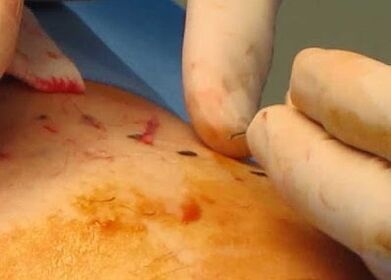
Miniphlectomy has replaced the classic operation of varicose veins, which involves the use of 1-3 cm incisions, because it is aesthetically flawless, painless and very effective.Assuming how varicose veins are manifested, the doctor can clearly plan micropuncture and deal with minimal intervention.After the operation, the patient can walk home on his own.Miniphlectomy can be an independent effective method of treating varicose veins, or combined use after laser coagulation of varicose veins.Varicose veins are removed using a special technique developed by Professor Varad.This technique has been perfectly mastered by our phlebologists and allows the removal of varicose veins on the legs - an effective treatment regardless of its cause.
Treatment results
Results of treatment of varicose veins
The results of modern therapy of varicose veins can be considered very good.Any technology, if performed well, will eliminate the symptoms of varicose veins in the legs.Almost 95% of patients do not have varicose veins for 5 years or more, and 80% of them never have serious venous drainage problems.The innovative vascular center is ready to help you deal with any venous disease without incision and pain.We know how to treat varicose veins and have a lot of experience.Treatment of varicose veins should not be a problem in today's high-tech world.